Iceland with Kids: What Turns a $1,392 Week into $5,356
What a week on the ground costs a family of four, read off each operator’s own price page.
Quick Answer
- A family of four pays ISK 169,277 ($1,392) or ISK 651,444 ($5,356) for the same seven day Iceland self drive, on each operator’s own published rates (as of September 2026, sources: Blue Car Rental, Fosshotel Reykjavik, Reykjavik Eco-Campsite).
- Every price on that trip is set in kronur, and the rental company states in writing that all transactions are made in ISK. Bring a card with no foreign transaction fee (as of September 2026, source: Blue Car Rental).
- The sun stays up about 21 hours at the June solstice in Reykjavik and never drops below the twilight limit (as of September 2026, source: US Naval Observatory), which rules an aurora out of a summer trip before any forecast does.
- The cheapest geothermal soak for the four of you costs less than one adult ticket at the famous one, and the city runs it, not a spa.
- One of the two lagoons on every Iceland shortlist will not admit a fifth grader at any price, and its own FAQ says staff may ask for ID to prove it.
- Skip Iceland if the airfare alone decides your budget, or if your children want warm water and a pool club: our winter family vacation ranking covers that trip instead.
- Below: the seven day table both totals come from, the month by month daylight figures that decide midnight sun against aurora, and a five day route with a driving cap.
Families price an Iceland trip off the airfare and assume the ground costs land in the middle. They do not. Seven nights in the only room at Iceland’s largest hotel that sleeps four came back at ISK 440,814, about $3,624, tax in (as of September 2026, source: Fosshotel Reykjavik), and the same four sleep legally on a city campsite pitch for ISK 7,105 a night. The next section carries both; the Budget Calculator runs them against your own dates.
What an Iceland Family Trip Actually Costs
The Real-Cost Test asks what a list price leaves out. In Iceland it is not a resort fee or a tipping convention; it is the child line. The country runs two price tiers for the same week: an outdoor and municipal tier where a child is free or nearly free, and a tourist tier where a child is priced close to an adult. Both columns below use the same rental, the same fuel and the same seven days; only the bed, the breakfast and the soak move.
| Line (family of four, seven days) | Outdoor tier | Tourist tier |
|---|---|---|
| Bed, seven nights | Reykjavik Eco-Campsite pitch, ISK 49,735 ($409) | Fosshotel family room, ISK 440,814 ($3,624) |
| Breakfast for four, seven mornings | Kronan porridge cups, ISK 5,292 ($44) | Hotel family breakfast, ISK 71,400 ($587) |
| One geothermal soak | Reykjavik city pool, ISK 3,000 ($25) | Blue Lagoon Comfort, from ISK 27,980 (from $230) |
| Car, seven days, automatic, two child seats, second driver | ISK 90,872 ($747) | ISK 90,872 ($747) |
| Fuel, 1,200 km | ISK 20,378 ($168) | ISK 20,378 ($168) |
| Seven day total, before flights | ISK 169,277 ($1,392) | ISK 651,444 ($5,356) |
Sources: Reykjavik Eco-Campsite; Fosshotel Reykjavik; Kronan; City of Reykjavik; Blue Lagoon; Blue Car Rental (own pages, as of September 2026), converted at 121.64 ISK to the dollar, the Central Bank of Iceland rate. The hotel row is the engine’s own seven night price for the only room that sleeps four, ISK 435,214 after its five night 15 percent discount, plus the 800 ISK a night lodging tax the engine excludes; the camp row is the campsite’s own online rate and already carries its 400 ISK tax, so both columns are priced tax in. The fuel row is this article’s own assumption: 1,200 km at 7 litres per 100 km at N1’s 242.6 ISK a litre, a deliberate upper bound: the route below drives 457 km. Priced at the route’s own 457 km instead, the fuel line is ISK 7,761 ($64), the outdoor week ISK 156,660 ($1,288) and the tourist week ISK 638,827 ($5,252); the gap between the columns does not move.
The gap is ISK 482,167, about $3,964 (as of September 2026), and nothing in the right hand column buys a different Iceland. Flights sit outside both columns: the fare from your airport is the one number this page cannot read off an Icelandic operator’s site; our cost by trip length guide handles that half.
What a Geothermal Soak Costs a Family of Four
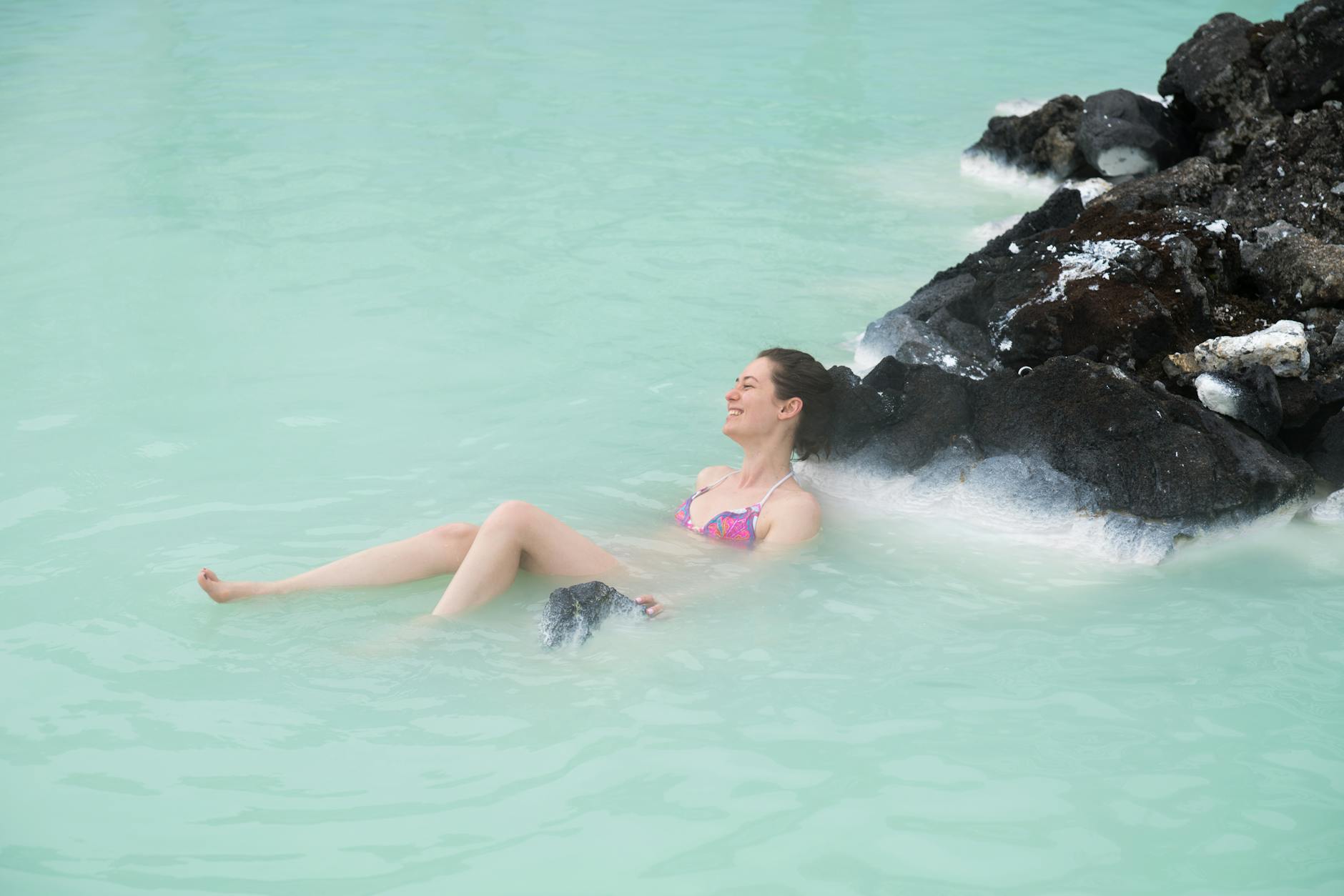
Reykjavik runs eight municipal pools, geothermally heated, open year round. The city tariff, approved in April 2026 and in force since May 2026, charges adults 1,500 ISK, children aged 10 to 17 400 ISK, and children aged nine and under nothing at all when a guardian brings them (as of September 2026, source: City of Reykjavik). Two adults and two under-tens pay ISK 3,000, about $25, for an afternoon.
The Blue Lagoon prices the same afternoon differently. Comfort admission starts at ISK 11,990 an adult and children aged 11 and under are ISK 2,000 each (as of September 2026, source: Blue Lagoon), so the same four come to ISK 27,980, about $230. That is 9.3 times the city pool at the lagoon’s cheapest published slot. Three conditions matter before you book: the minimum age is two, under-nines must wear the floaties it hands out free, and one adult may bring a maximum of two children, so two adults and three children cannot walk in as they stand.
Sky Lagoon starts where the Blue Lagoon’s child fare ends. Its own FAQ states that children under 12 are not permitted, that visitors aged 12 to 14 must be with a guardian aged 18 or over, and that staff may ask for ID; for twelve and over its price page, read in the kronur it charges in, lists the Saman Pass youth fare at ISK 7,495, about $62, against ISK 14,990, about $123, an adult (as of September 2026, source: Sky Lagoon). With a ten or eleven year old, no price on that page is available to you. Most guides name the two lagoons in one sentence; they stop being interchangeable the moment you have an eleven year old.
“we did the Laugardalslaug (Reykjavik public pool) and it was definitely one of the highlights for my kids”
Commenter in r/VisitingIceland, lagoons thread, August 2026
What Is the Best Month to Go to Iceland with Kids?
Daylight, not temperature, changes an Iceland trip for children, and the swing is roughly five to one. US Naval Observatory figures for Reykjavik, on the fifteenth of each month.
| Month (fifteenth) | Sunrise | Sunset | Daylight |
|---|---|---|---|
| January | 10:55 | 16:19 | 5 h 24 m |
| February | 09:24 | 18:01 | 8 h 37 m |
| March | 07:47 | 19:28 | 11 h 41 m |
| April | 05:57 | 21:01 | 15 h 04 m |
| May | 04:14 | 22:37 | 18 h 23 m |
| June | 02:58 | 00:00 (16 June) | 21 h 02 m |
| July | 03:40 | 23:25 | 19 h 45 m |
| August | 05:18 | 21:44 | 16 h 26 m |
| September | 06:50 | 19:54 | 13 h 04 m |
| October | 08:17 | 18:09 | 9 h 52 m |
| November | 09:56 | 16:28 | 6 h 32 m |
| December | 11:16 | 15:29 | 4 h 13 m |
Source: US Naval Observatory sunrise and sunset tables for Reykjavik, 64.1466 N 21.9426 W, 2027, queried as of September 2026. Iceland keeps UTC all year, so no daylight saving applies. Reykjavik sits below the Arctic Circle, so the sun sets every night: on 15 June it goes down at midnight, the sunset the Observatory files against the following day, and at the solstice it is below the horizon for under three hours and never far enough below it to go dark.
At the December solstice the sun rises at 11:22 and sets at 15:29, 4 hours and 7 minutes of sun, with civil twilight stretching usable light to about 6 hours 46 minutes (as of September 2026, source: US Naval Observatory).
The Icelandic Met Office, which publishes Iceland’s official aurora forecast on a 0 to 9 scale, states the condition in one line: the aurora requires dark and partly clear skies (as of September 2026, source: Icelandic Met Office). June has none at any hour, so the answer splits by age. Under about six, go May to August, when a 21 hour day makes a late nap and a 9pm dinner free. Over about eight, if the northern lights are the point, go September to March and accept short days, winter driving and the Met Office forecast as your evening planner.
What Is the Best Age to Take Kids to Iceland?
Iceland answers this one itself, in the age cut-offs its operators publish: a city pool free to nine, a campsite pitch free to twelve, a Blue Lagoon child fare to eleven and no entry under two, and Sky Lagoon shut to anyone under twelve. Stack them and the cheap version of Iceland is widest between roughly six and eleven, old enough to walk a headland in weather and young enough that three of the four price lines still treat them as a child (as of September 2026, sources: City of Reykjavik, Reykjavik Eco-Campsite, Blue Lagoon, Sky Lagoon).
Under two is the awkward band, and not for the reason parents expect: the obstacle is not the weather but that the country’s signature warm-water stop is closed to you.
Who Should Skip Iceland: The Skip-If Filter
Five conditions, any one of which should send you elsewhere this year.
Your budget is fixed and your family needs hotel rooms
Iceland’s largest hotel sells one room type that sleeps four, its 15 percent discount needs a five night stay, and its 800 ISK a night lodging tax is charged on arrival on top of the quoted rate (as of September 2026, source: Fosshotel Reykjavik). If an indoor room is non-negotiable, only the right hand column is open to you.
You want the South Coast on this trip
Reynisfjara and back is 4 h 13 m at the wheel on the road authority’s own figures, so it is not on the route above. A moving base is the other way to have it.
A beach day is the point of the holiday
The famous beach is a hazard site with a traffic light at the entrance, and its own safety page states that children must always be accompanied by an adult and that sneaker waves can sweep an adult out to sea in seconds. Its three light system is published too: yellow means stay alert; orange, stay at least 25 m (82 ft) from the sea; red, the beach is closed and viewing moves to the designated area (as of September 2026, source: safetravel.is).
You were counting on a spa day with an under-twelve
One headline lagoon will not admit them; the other caps one adult at two children in the water.
You planned to camp wherever you stop
The cheap column assumes booked campsites; pitching a tent where you stop is not legal here.
The objection that comes up on the forums is not the price. It is the driving, from a commenter who does not think Iceland is kid friendly at all:
“Long drives, cold and wet weather. I don’t even remember seeing a single playground.”
Commenter, r/VisitingIceland, “1,5 year old in March” thread, August 2026
The route section below is built against exactly that objection: the route drives 457 km, capped at three hours behind the wheel in a day and no leg over two hours without a stop.
Renting the Car, and the Extras That Are Not Included
Blue Car Rental’s own quotes for a seven day Keflavik Airport pickup in June 2027, in kronur, each total as the endpoint returns it, net of the discounts it applies itself.
| Car | Drive | Seats | Gearbox | Seven days |
|---|---|---|---|---|
| Kia Rio | Front wheel | 5 | Manual | ISK 72,172 ($593) |
| Toyota Yaris | Front wheel | 5 | Automatic | ISK 73,122 ($601) |
| Dacia Duster, earlier model | Four wheel | 5 | Manual | ISK 77,450 ($637) |
| Dacia Jogger | Front wheel | 7 | Manual | ISK 78,362 ($644) |
| Suzuki Vitara | All wheel | 5 | Automatic | ISK 103,923 ($854) |
| Kia Sorento | Four wheel | 7 | Automatic | ISK 162,207 ($1,334) |
Source: Blue Car Rental’s own pricing endpoint, Keflavik Airport, seven days in June 2027, as of September 2026. Each total is net of the rental’s own discounts, including a seventh-day one it itemises at 900 ISK a day; the collision waiver is in the rate and no insurance charge is added. Of the 33 classes returned, each row is the cheapest in its own seat, drive and gearbox combination; the three other five seat combinations all start above ISK 105,000. Two cheaper four seat Toyota Aygos exist, from ISK 62,296, and seat this family exactly, but each takes one large bag against the Yaris’s two. Child seats and a second driver are extra.
Both premiums in that table are drive, not gearbox. Cheapest five seat manual against cheapest five seat four wheel drive manual, the four wheel drive premium is 7.3 percent, smaller than its reputation. Among automatics the table’s own step up is to an all wheel drive Suzuki Vitara, 42.1 percent over the front wheel drive; the cheapest true four wheel drive automatic, a Kia Sportage at ISK 109,840, is 50.2 percent up. Changing gearbox alone is the cheap change: the automatic front wheel drive is 1.3 percent above the manual, ISK 950 over seven days (as of September 2026, source: Blue Car Rental).
Now the part the headline rate leaves out. Child seats are an extra on every quote and are not optional: safetravel.is states that children under 135 cm are legally required to use one (as of September 2026, source: ICE SAR). A baby seat is 4,500 ISK one-time, a booster 1,000 ISK, a second driver 1,250 ISK a day, so two baby seats and a second driver over seven days add ISK 17,750, about $146; with a booster in place of the second baby seat it is ISK 14,250. Insurance runs the other way: the rental’s insurance page puts gravel, windscreen, headlight and paint cover in every rental, which its own pricing blog sells as an add-on, while sand and ash are chargeable and the tyres and underside stay uncovered unless you buy the liability waiver (as of September 2026, source: Blue Car Rental). Our guide to hidden family vacation fees tracks the same pattern elsewhere.
A Five Day Reykjavik Based Route with a Driving Cap
The cap is this article’s own rule, not a sourced figure: no more than three hours behind the wheel in a day with children under ten, and no leg over two hours without a stop. ICE SAR says do not schedule long days and stops short of a day total, but its fatigue page does publish an interval: make a stop at least every 100 km or so (as of September 2026, source: safetravel.is). The cap is also why the south coast is not on this list: Reynisfjara and back is 374 km and 4 h 13 m, which does not fit inside it, and why the budget above prices seven nights on one base. Two of the five days drive nothing; the budget carries the car for the whole week anyway, because both columns price the same seven day rental and its fuel line is a stated upper bound, not this route. Each day carries a published safety rule worth knowing on that trip.
| Day | Driving | What the day holds | A rule worth knowing |
|---|---|---|---|
| 1 | None | Collect the car, go no further, spend the afternoon in a municipal pool. | Do not drive straight off an overnight flight from America. Safetravel.is names it as the risk. |
| 2 | 231 km, 2 h 43 m | Golden Circle loop, three stops. | Single lane bridges are signed at 50 km/h, you stop for oncoming traffic, and the car that arrives first has right of way. Everyone belts in, back seat included. |
| 3 | 132 km, 1 h 38 m | Reykjanes peninsula, lava fields and the lighthouse coast. | Safetravel.is keeps Reykjanes flagged as hazardous from volcanic unrest: stay on marked paths, never walk on the lava, and if evacuation sirens sound, leave town by the exits you noted on arrival. Check the air at loftgaedi.is, the air quality site safetravel links. The day is optional: nothing in either budget column depends on it. |
| 4 | None, or one short drive | A second pool and the city on foot. | Lokad on a sign means closed, and safetravel.is adds: we do not close roads unless it is urgently needed. |
| 5 | 94 km, 1 h 10 m | City pool or the lagoon, depending which column you are in. | The lagoon caps one adult at two children, and under-nines wear the floaties it hands out. |
Distances and journey times are the Icelandic Road Administration’s own, from its Vegalengdir table, summed over the legs each day drives and using the all-paved route where it also publishes a mountain one (as of September 2026, source: Vegagerdin). Safety rules are as published by ICE SAR on safetravel.is and by Blue Lagoon. For day 3 the Icelandic Met Office’s current hazard assessment, dated 15 September and valid to 30 September, makes a new magma intrusion the likeliest outcome, and its 18 August update put warning times for past eruptions between about 20 minutes and just over four hours (as of September 2026, source: Icelandic Met Office). The three hour cap itself is editorial.
Do and Don’ts in Iceland: The Rules That Apply to Children
ICE SAR, behind safetravel.is, publishes the list most family guides paraphrase. One current item almost none of them carries deserves its own wording.
Do check that your handset works on current networks before you fly. Iceland began shutting down 2G and 3G in April, and safetravel.is warns plainly that this may affect access to the emergency number 112. Every page on the site now carries a backup number, 599-0112, and notes that where coverage is thin a text message often gets through when a call will not (as of September 2026, source: safetravel.is).
The rest of that list sits in the route table above. Two more belong with it: do not wild camp: tents and campers belong on a campsite or on private land with permission, and do not assume a summer tent is enough, because the same page recommends a three season tent even in July (as of September 2026, source: safetravel.is).
What to Pack for Iceland with Kids
Two items here come from numbers earlier on this page. A swimsuit and towel per person: Reykjavik’s pools rent swimwear at 1,270 ISK and a towel at 860 ISK a visit (as of September 2026, source: City of Reykjavik). And a sleeping mask, which safetravel.is recommends because summer here runs on almost 24 hours of daylight, and which is the difference between a five year old asleep at nine and awake at midnight in broad daylight.
After that: waterproof outer layers rather than a warm coat, because the weather that catches families is horizontal rain; no floaties, since the Blue Lagoon supplies them free to under-nines; and one card with no foreign transaction fee, because every charge on the trip lands in kronur.
Our Take
Iceland with children is neither expensive nor cheap. It is two prices for the same week, decided by three choices made before you book anything: where the four of you sleep, who cooks breakfast and which hot water you get into. Take the outdoor tier on all three and the week on the ground is $1,392. Take the tourist tier on all three and it is $5,356, a multiple of 3.8, with the same car parked outside.
What we would book with a six to eleven year old is a split: campsite or guesthouse nights with supermarket breakfasts, an automatic front wheel drive rather than the four wheel drive the brochures push, city pools most days, and one lagoon visit as a treat. That is the left hand column with one line moved across, and it lands far under the right hand one without asking a child to sleep in a tent for seven nights. Under two or over twelve, run the table again: both ends of that range lose discounts the middle keeps.
Frequently Asked Questions
What is the best age to take kids to Iceland?
Six to eleven is the band where Iceland is cheapest and easiest. Under ten a child swims free at a Reykjavik city pool with a guardian, and up to twelve a child sleeps free on a campsite pitch; at eleven and under, the Blue Lagoon charges ISK 2,000 rather than an adult fare. Those three discounts expire between ages ten and twelve, and Sky Lagoon does not admit anyone under twelve at all. Under two, the Blue Lagoon is closed to you entirely (as of September 2026, sources: City of Reykjavik, Reykjavik Eco-Campsite, Blue Lagoon, Sky Lagoon).
Do they accept US dollars in Iceland?
No. Iceland prices and charges in kronur, and you pay by card. Blue Car Rental states on its own extras page that all transactions are made in ISK; the city pool tariff, the campsite price list, the hotel booking engine and the supermarket product pages all quote ISK and nothing else. Both lagoons default to dollars for an American visitor and switch to kronur on request, which is a display conversion, not a payment currency: the charge still lands in ISK. What you need is a card with no foreign transaction fee, not cash. The Central Bank of Iceland put the dollar at 121.64 ISK (as of September 2026, source: Central Bank of Iceland).
Do and don'ts in Iceland?
The rules that matter with children are published by ICE SAR on safetravel.is. Do wear seatbelts in the back seat, do slow to 50 km/h on single lane bridges, do treat Lokad on a sign as closed, and do check that your phone still works on current networks before you fly, because 2G and 3G are being shut down and that may affect access to the emergency number 112 (the backup number is 599-0112). Do not wild camp, which is not permitted. Do not drive straight from an overnight flight. Do not stand near the water at Reynisfjara: sneaker waves there can sweep an adult out to sea in seconds (as of September 2026, source: safetravel.is).
What is the best month to go to Iceland?
It depends on which trip you want, and the daylight decides it. At the June solstice the US Naval Observatory records the sun as continuously above the twilight limit in Reykjavik, so it never gets dark and an aurora is impossible. At the December solstice the same source gives 4 hours and 7 minutes of sun, against 4 h 13 m on 15 December, the day the daylight table above lists. May to August suits under-sixes, because a 21 hour day makes a late nap free. September to March is the only aurora window, and the Icelandic Met Office states the condition plainly: the aurora needs dark and partly clear skies (as of September 2026, sources: US Naval Observatory, Icelandic Met Office).
How much does a family trip to Iceland cost?
On the ground, a family of four can do the same seven day self drive for ISK 169,277 ($1,392) or ISK 651,444 ($5,356), before flights. Both columns use the same rental car, the same fuel and the same seven days on the same road; only the bed, the breakfast and the geothermal soak change. The gap is ISK 482,167, about $3,964, and all of it comes from lines that are priced by how old your children are (as of September 2026, sources: Blue Car Rental, Fosshotel Reykjavik, Reykjavik Eco-Campsite, Kronan, Blue Lagoon, City of Reykjavik, N1).
Can kids go to the Blue Lagoon?
Yes, from the age of two. The Blue Lagoon sets a minimum age of two, charges ISK 2,000 for children aged eleven and under, requires floaties for children aged eight and under and hands them out free at the lagoon entrance, and allows one adult to accompany a maximum of two children, so a party of two adults and three children cannot enter as it stands. Sky Lagoon is different: its own FAQ states that children under the age of 12 are not permitted (as of September 2026, sources: Blue Lagoon, Sky Lagoon).
Data Sources and Verification
Every figure here was read on the operator’s own page in September 2026 for one basket: two adults and two children under ten, seven days, self drive from Keflavik, June 2027 dates. Kronur are converted once, at the Central Bank of Iceland’s own published rate.
- Central Bank of Iceland: official exchange rate
- Blue Car Rental: published extras and child seats · seven day quote engine
- Fosshotel Reykjavik: room rates and family room availability
- Reykjavik Eco-Campsite: pitch tariff
- City of Reykjavik: swimming pool tariff · pool network
- Blue Lagoon: admission types · children policy
- Sky Lagoon: age policy FAQ · tickets and prices
- Kronan: porridge cup product page
- Vegagerdin (Icelandic Road Administration): Vegalengdir distance and journey time table
- Icelandic Met Office: Reykjanes hazard assessment
- N1: fuel price list
- US Naval Observatory: sunrise and sunset table query form (Reykjavik 64.1466 N, 21.9426 W)
- Icelandic Met Office: official aurora forecast
- ICE SAR (safetravel.is): Reynisfjara safety · 2G and 3G phase out · driving, top 12 tips · camping · eruption in Reykjanes
- Reddit: r/VisitingIceland, lagoons thread · r/VisitingIceland, “1,5 year old in March” thread
How we checked these figures
All prices were read in September 2026 on the pages linked above and converted once at 121.64 ISK to the dollar, the Central Bank of Iceland’s published rate on the day of the read. Car and hotel quotes use a fixed travel window of 15 to 22 June 2027 from Keflavik Airport so a reader can reproduce them, while the campsite line is that site’s own standing online tariff, the only rate it publishes, on a page still headed for 2026; the car figures come from the rental’s own pricing endpoint rather than its client-rendered grid. The hotel line is the price the hotel’s own engine returns for those seven nights in the only room that sleeps four, ISK 435,214 room only after its five night discount, plus the 800 ISK a night lodging tax the engine prints as excluded; the campsite line already carries its own 400 ISK a night tax, so the two columns are comparable. The hotel breakfast line is the engine’s own difference between its room-only and breakfast-included rates for the same seven nights, ISK 506,614 against ISK 435,214, divided by seven. The fuel line is the only modelled row in the budget table: 1,200 km at 7 litres per 100 km and N1’s published list price, all three stated so they can be replaced. One figure is not published because no owner-published source could be reached: a weekly supermarket basket, since only individual product pages are readable. The outdoor column prices the pitch, not the kit: it assumes a family that already owns or flies with a tent, sleeping bags and mats, which safetravel.is says should be three season even in July, and the tourist column needs none of that. Both Reddit quotes were read on the thread pages themselves, not on a mirror, and are reproduced verbatim. Our full method is at about/methodology.
Prices change. Re-check the linked pages before booking; all figures on this page were current as of September 2026.